


Your shopping cart
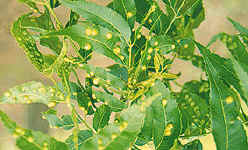 |
| Damage to foliage by pecan phylloxera University of Missouri |
Life cycle
Three species of phylloxera (Phylloxera devastratrix) are pecan pests, but only the pecan phylloxera causes economic damage in certain years. The pecan leaf phylloxera and the southern pecan leaf phylloxera feed primarily on the foliage, whereas the pecan phylloxera attacks the foliage, shoots and fruit and is therefore the most damaging (see above image). The pecan phylloxera is a small, aphid-like insect that is rarely seen, but the galls it produces are prominent and easily noticed. Severe infestations cause malformed, weakened shoots that finally die; such infestations can destroy entire limbs.
The pecan phylloxera overwinters as eggs located inside the dead body of a female adult, which is in protected places on the branches of pecan trees. Soon after budbreak, the eggs hatch and the young insects migrate to opening buds or leaf tissue to feed on expanding new growth. The individuals that hatch from the overwintering eggs are known as stem mothers. Feeding by the stem mothers stimulates the development of galls, which enclose the stem mother in a few days. Inside the gall, the stem mother matures, lays her eggs and dies. Eggs laid by the stem mother hatch within the gall, and these nymphs feed within the gall until they mature.
In early July, the galls split open and the mature nymphs emerge as winged, asexual adults. These adults migrate to other trees or other parts of the same tree and lay eggs that are of two sizes. The smaller eggs hatch into male sexuals, and the larger eggs hatch into female sexuals. Male and female sexuals do not feed; their sole purpose is to mate and produce the overwintering egg. After mating, female sexuals seek out sheltered places on a tree, where they die with a fertilized egg inside them, protected for the winter.
Description
The adults and nymphs are small, one-eighth inch long, soft-bodied and cream-colored. They resemble aphids without cornicles (the protruding tubes located on the dorsal end of aphids). You'll need a hand lens to observe and identify them.
Scouting and control
Because the galls are seen easily, pecan phylloxera infestations often appear worse than they are. Only when galls occur on large numbers of shoots or nuts should you consider insecticides for the next season. Timing of control is critical, and you must target insecticide applications toward the stem mothers. Apply sprays from budbreak to one inch of new growth. Once the galls appear, it is too late to control pecan phylloxera for the season. Often only the trees that were infested the previous year will need treatment, not the entire orchard. Certain native trees and grafted varieties within an orchard become more heavily infested than other trees. Spraying or even removing these trees can prevent economic infestations from spreading throughout the entire orchard.
George S. Smith and Maureen H. O'Day
Department of Entomology, University of Missouri-Columbia
William Reid
Kansas State University