


Your shopping cart
 |
 |
|
Western spruce budworm adult Colorado State University Extension Service |
Western spruce budworm egg mass on needle Colorado State University Extension Service |
Quick Facts...
-
Western spruce budworms are the most important tree defoliators in the West.
-
Budworm larvae eat the new growth of host trees.
-
Douglas-fir is often the favored host.
-
Budworm has a one-year life cycle.
-
Budworm control measures usually are conducted in June.
Description and Life Cycle
The western spruce budworm, Choristoneura occidentalis Freeman, is the most widely distributed and destructive forest defoliator in western North America. Several outbreaks have occurred in Colorado, the largest exceeding two million acres. They commonly infest Douglas-fir and white fir. Occasionally, they also attack Engelmann spruce, blue spruce and sub-alpine fir.
Western spruce budworm adults normally are small, mottled, rusty-brown moths, but color can vary from tan to almost black. After mating, females lay masses of overlapping green eggs on the undersides of needles. The masses consist of 25 to 40 eggs that hatch in about 10 days. The young larvae do not feed but move to crevices under bark scales or lichens where they spin silken shelters called hibernaculae. There they remain dormant throughout the winter.
In late April or May, the larvae migrate to the foliage, where they mine old needles or feed on host tree flowers. In a week or two, they enter developing buds, the habit that gives them their name. As the new needles lengthen, the rapidly growing larvae continue to feed. It is during this stage that most of the damage occurs. They web the new foliage together loosely and feed inside, where they are somewhat protected from predators and other enemies.
In the late larval stages, budworms have brownish heads and brownish-olive bodies. Each body segment has two conspicuous pairs of white spots. About 40 days after feeding begins in the spring, usually about the end of June, the larvae pupate inside feeding webs or on foliage. Adults emerge a week or so later and the cycle is complete. There is one generation per year.
 |
|
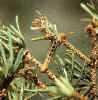
Western spruce budworm larva |
Damage and Associated Impact
Budworms are important because they can eat all the new growth produced by host trees. The new needles are most important in producing food for the tree, so the immediate effect of defoliation is a reduction in growth.
To the homeowner, defoliation mostly means a loss of aesthetic value. As defoliation progresses, both in extent and duration, more significant impacts are likely. The foliage, especially the branch tips, turns brown and dies. Twigs, branches or entire tops of trees may be killed. During long-running outbreaks, three to five years or more, about one tree in four will die. Non-fatal defoliation may also lead to infestation by the Douglas-fir beetle or other bark beetles. In turn, these can kill the tree.
Prevention
Budworms like forest stands that are dense, dominated by host species of all sizes, surrounded by similar forests, and stressed. Silviculture practices that thin forests, convert them to non-host species, or limit host species to one size help prevent serious damage. This is the long-term solution to budworm.
Control
Budworm populations usually are held in check by a combination of predators, parasites, adverse climatic conditions, or inadequate food supply. Spiders, insects and a variety of birds are important predators. Adverse weather conditions, particularly sudden freezes in late spring, may kill large numbers of larvae. A major factor in ending long-term outbreaks appears to be starvation from inadequate or nutritionally poor food sources. However, this may not be a factor in urban situations. Cultural practices such as thinning, watering and fertilizing, which promote tree vigor, may help trees better withstand repeated attacks.
Chemical control often is used to protect high-value trees from defoliation and associated damage. The materials listed below are registered for western spruce budworm control and have been used with some success. They can be applied both from the ground and aerially. In either case, time spraying to occur during the two to three weeks immediately following budbreak or flush of new growth. In most years, this occurs about mid-June.
| Table 1: Insecticides for control of western spruce budworm. | |
| Insecticide | Trade name |
| acephate | Orthene |
| Bt (Bacillus thuringiensis) | Dipel, Thuricide |
| carbaryl | Sevin |
Related Insects
A close relative of western spruce budworm is the so-called pine budworm, Choristoneura lambertiana ponderosana (Obraztsov). This species attacks pines, especially ponderosa pine, and occasionally causes serious damage to individual trees. However, it is not normally an important defoliator in the urban environment.
Information provided by the Colorado State University Extension Service